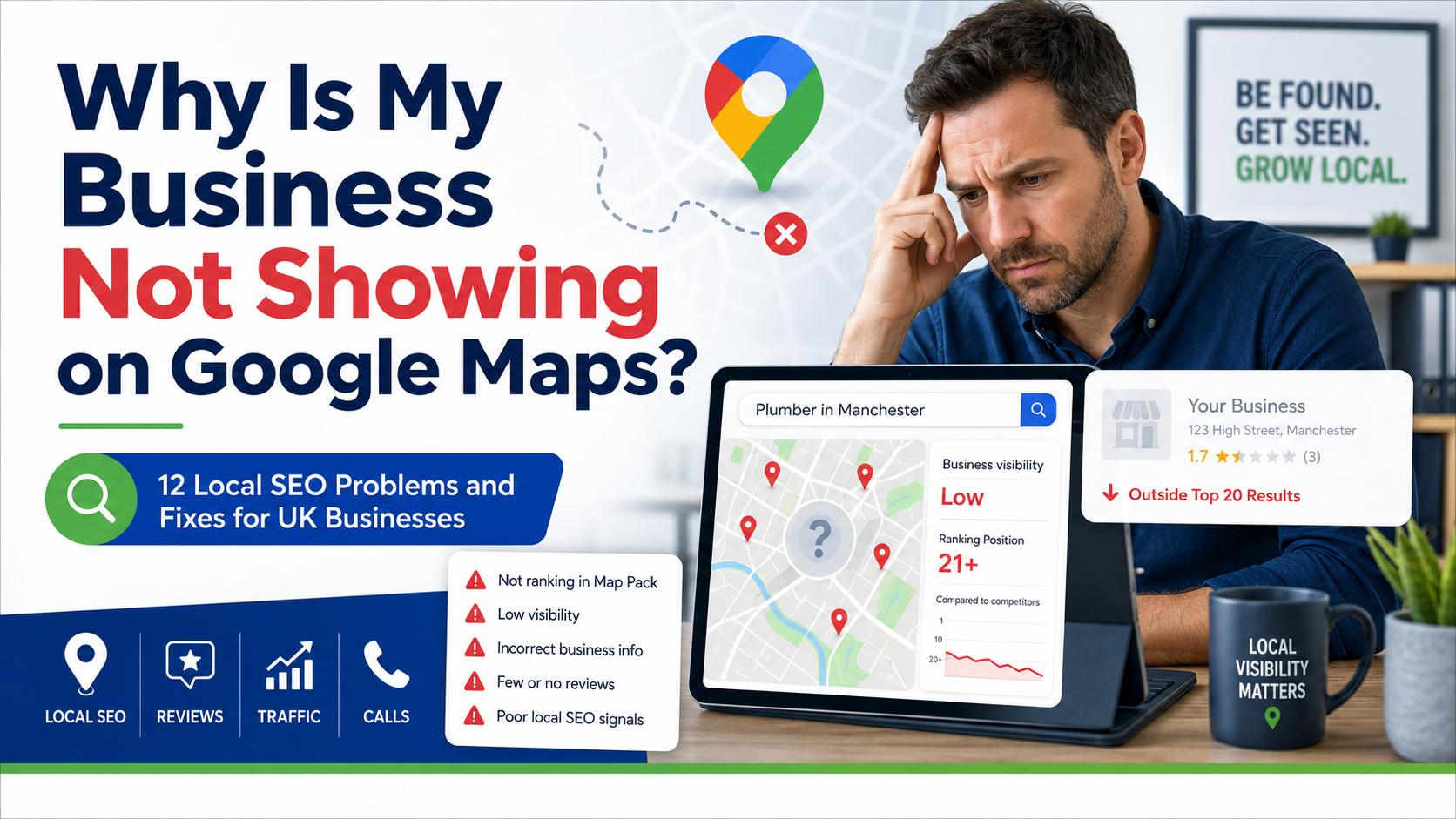
Your Google Business Profile is verified. Your website is live. Your business is open and ready to serve customers.
However, when you search for your main service on Google Maps, your business does not appear.
In some cases, your business only appears when you search for its exact name. In other cases, nearby competitors appear at the top while your profile is difficult to find.
This is a serious problem for local businesses.
Customers often use Google Search and Google Maps when they need a nearby plumber, dentist, restaurant, solicitor, accountant, builder, clinic or marketing agency. If your business is not visible, those customers may contact a competitor instead.
The good news is that many Google Maps visibility problems can be identified and improved. You must first understand whether your profile is completely missing or simply ranking below stronger competitors.
This guide explains 12 common reasons why a business may not appear on Google Maps and provides practical fixes for UK business owners.
Google Maps Visibility and Google Maps Ranking Are Not the Same
Before changing your profile, identify the exact problem.
Your business is not showing at all
This may happen because:
- The profile has not been verified
- The profile has been suspended or disabled
- Google considers it a duplicate
- The business information is incorrect
- The profile is not eligible
- Important changes are still being reviewed
Your business appears, but below competitors
This is normally a local ranking problem.
Google says local results are mainly based on three factors:
- Relevance: How closely the business matches the customer’s search
- Distance: How far the business is from the searcher or searched location
- Prominence: How well-known and trusted the business appears
Google does not offer a way to pay or request a better organic local ranking.
Understanding this difference can save time. Adding more photographs will not fix a suspended profile, while completing verification alone will not guarantee a top-three position.
Quick Google Maps Visibility Diagnosis

Always begin with the issue that best matches what you are seeing.
1. Your Google Business Profile Has Not Been Verified
Verification confirms that you are authorised to manage and represent the business.
A profile may exist on Google Maps without being fully verified, but an unverified business has limited control over its information and may struggle to appear properly in relevant results.
Google decides which verification methods are available. Depending on the business, location and public information, the options may include:
- Video recording
- Phone or text
- Live video call
- Post
Some businesses may need to complete more than one verification method.
How to check
Sign in to the Google account used to manage the profile.
Search for your business name on Google. Look for messages such as:
- Get verified
- Verification required
- Processing
- Reverify your business
- Your business is not visible to customers
How to fix it
Complete the verification method Google offers.
Make sure the information and evidence match the profile, including:
- Business name
- Address
- Telephone number
- Website
- Permanent signage
- Business documents
- Branded vehicles or equipment
- Proof that you manage the location
For video verification, Google may ask for evidence of the business location, proof that the business exists and proof that you manage it. Service-area businesses may need to show business documents, work equipment or a branded vehicle instead of a customer-facing shop.
Do not change your business name, address or category repeatedly during verification. Major changes can delay the process or lead to another verification request.
2. Your Profile Has Been Suspended or Disabled
A suspended or disabled profile may disappear from Google Search and Maps.
Google can restrict a Business Profile when the profile or account does not follow its policies. The business must fix the problem and use the official appeal process if it believes the profile should be restored.
Common warning signs
You may see a message saying:
- Your Business Profile has been suspended
- Your profile has been disabled
- Your business is not visible to customers
- Your access has been restricted
- Your profile does not follow the guidelines
Possible causes
Common profile problems include:
- Adding keywords to the business name
- Using an address where the business does not operate
- Showing a home address when customers are not served there
- Creating several profiles for the same business
- Providing misleading business information
- Selecting unrelated categories
- Using an ineligible virtual office
- Making the business appear different from how it operates in real life
Your profile name should normally match the name customers see on your website, signage, stationery and other business materials.
How to fix it
Before submitting an appeal:
- Review every field in your profile.
- Remove unnecessary keywords from the business name.
- Confirm that your address or service area is accurate.
- Check that the business is eligible for a profile.
- Remove misleading or unrelated information.
- Prepare proof of the business.
Useful evidence may include:
- Company registration documents
- Utility bills
- Business licence
- Lease agreement
- Photographs of permanent signage
- Invoices
- Branded vehicles
- Photographs of the working location
Fix the possible violation before appealing. Repeatedly submitting appeals without correcting the profile is unlikely to solve the problem.
Google says appeal decisions may take several business days and advises businesses not to submit repeated appeals for the same issue before receiving a decision.
3. You Selected the Wrong Business Category
Your primary category helps Google understand what your business is.
For example, a dental clinic should not use a broad category simply because it offers several related services. It should choose the category that most accurately represents its main business.
Google advises businesses to select categories that describe what the business is, rather than everything it has or every service it offers.
Why the category matters
Imagine that you run a company providing boiler repairs.
If your primary category describes a general construction business, Google may not clearly understand that your company is relevant to searches for:
- Boiler repair near me
- Emergency heating engineer
- Gas boiler service
- Local heating company
A more accurate category can help Google match the profile with more relevant searches.
How to fix it
Choose:
- One specific primary category for your main business
- Only relevant additional categories
- Categories that describe services you genuinely provide
Do not add unrelated categories simply because they may attract more searches.
Google allows profile owners to edit the primary category and add relevant additional categories through the Business Profile settings.
After changing a category, allow time for the update to be reviewed and reflected publicly.
4. Your Business Information Is Incomplete
Google cannot match your business confidently with local searches when important information is missing.
A profile containing only a business name and telephone number gives Google and customers very little context.
Google recommends keeping profile information complete, accurate and current. This includes details such as the address, telephone number, business type and opening hours.
Information you should complete
Check the following:
- Business name
- Primary category
- Additional categories
- Address or service area
- Telephone number
- Website
- Normal opening hours
- Special opening hours
- Business description
- Services
- Products where relevant
- Attributes
- Appointment or booking links
- Photographs
- Logo
- Opening date
How to improve it
Use clear and accurate information.
Avoid:
- Adding keywords unnaturally
- Making exaggerated claims
- Listing services you do not provide
- Copying a competitor’s description
- Using an incorrect location
- Leaving old opening hours active
- Sending users to a broken website page
Your profile should make it easy for a customer to understand:
- What you do
- Where you work
- When you are open
- How to contact you
- What action to take next
Completeness does not guarantee the top position, but incomplete information can reduce relevance and make customers less confident about contacting you.

5. Google Does Not See Your Business as Relevant
Relevance is how closely your profile matches what someone is searching for.
A profile may appear for the business name but not for important service searches.
For example, a company may appear when someone searches:
Smith & Sons Ltd
But it may not appear for:
Emergency plumber in Leeds
This often means Google understands the brand name but does not have enough information to connect the business with the service.
Possible causes
- Incorrect primary category
- Missing services
- Very short business description
- Weak service pages on the website
- No local information
- Website content that does not match the profile
- No clear explanation of specialist services
How to fix it
Connect the profile and website around the same real services.
For example, a dental clinic offering implants, emergency appointments and cosmetic dentistry should have:
- Accurate profile categories
- Relevant services listed on the profile
- A detailed dental implants page
- An emergency dentist page
- A cosmetic dentistry page
- Clear location and contact information
- Useful frequently asked questions
Do not repeat the target keyword unnaturally across the profile.
Instead, provide enough accurate information for Google and customers to understand the business.
Your website also needs detailed service pages. A few sentences on the homepage may not provide enough information for important local searches.
Businesses with wider website visibility problems should first review the Rugmaz guide, Why Is My Website Not Ranking on Google?
6. The Searcher Is Too Far from Your Business
Distance is a major part of local search.
A business may appear when someone searches from one area but disappear when the same search is made several miles away.
This does not always mean the profile has a problem.
Google considers how far each business is from the searcher or from the location included in the search. When a person does not include a location, Google may use available information about where that person is searching from.
Example
A solicitor located in central Birmingham may rank well for someone searching nearby.
The same solicitor may not appear prominently for a person searching from a distant part of the West Midlands, especially when closer relevant firms are available.
Can you fix distance?
You cannot fully control where a customer searches from.
You can improve relevance and prominence, but you should not:
- Add a false address
- Create profiles for locations where you do not operate
- Use virtual offices to appear in more towns
- Create duplicate service-area profiles
- Stuff city names into the business name
What you can do
Focus on the locations you genuinely serve.
Create useful location content where there is a real business reason, such as:
- Local service details
- Genuine projects in the area
- Customer examples
- Delivery information
- Travel or appointment information
- Area-specific frequently asked questions
Do not create dozens of near-identical city pages.
7. Your Competitors Have Stronger Local Prominence
Prominence refers to how well-known a business appears.
Google says prominence can be influenced by information available across the web, including links to the business and customer reviews.
A competitor may have:
- More genuine reviews
- Stronger review ratings
- A better-known brand
- More local mentions
- A stronger website
- Relevant backlinks
- Longer business history
- More useful content
- Better engagement from customers
This does not mean you should copy everything the competitor does.
How to improve prominence
Build a genuine local presence:
- Publish useful local guides
- Earn coverage from local publications
- Join relevant industry organisations
- Build relationships with suppliers and partners
- Publish case studies
- Keep business information accurate
- Earn reviews from real customers
- Improve your website
- Respond to customer feedback
- Share genuine business photographs
Avoid purchasing hundreds of directory links or fake reviews. Local authority develops through real business activity, useful information and trust.
8. You Have Too Few Genuine Customer Reviews
Reviews help customers compare local companies.
Google also confirms that more reviews and positive ratings can support local ranking, although reviews are only one part of the wider local ranking system.
A business with no recent reviews may look inactive, even when it is operating normally.
How to request reviews properly
Ask real customers after:
- Completing a service
- Delivering a product
- Finishing an appointment
- Resolving a customer problem
- Receiving positive feedback
Google allows businesses to create a review link or QR code that can be shared with customers.
You can place it in:
- Follow-up emails
- WhatsApp messages
- Printed receipts
- Thank-you cards
- Customer service messages
What not to do
Avoid:
- Buying reviews
- Asking staff to create fake customer accounts
- Offering rewards only for positive reviews
- Posting several reviews from the same location or device
- Asking customers to include exact keywords
- Threatening customers over negative feedback
Respond to reviews
Reply in a calm and professional way.
Thank customers for positive reviews and address negative reviews without becoming defensive.
Google recommends clear, helpful and polite responses.
A professional response can improve trust even when the original review is critical.
9. Your Business Details Are Inconsistent Online
Your business name, address and telephone number should be accurate wherever customers find you.
Problems can happen when different websites show:
- An old address
- An old telephone number
- Different business names
- Incorrect opening hours
- A previous website
- Duplicate directory listings
These inconsistencies can confuse customers and make it harder to confirm which details are correct.
Where to check
Review:
- Google Business Profile
- Your website
- Yell
- Bing Places
- Apple Maps
- Industry directories
- Local directories
- Professional membership websites
- Supplier and partner websites
How to fix it
Choose one correct version of your details and update important listings.
Your website should clearly display:
- Business name
- Telephone number
- Email address
- Address or service area
- Opening hours
- Contact page
For a business with a physical location, the address should match the real place customers visit.
For a service-area business, do not publicly display a home address when customers are not served there.
10. Your Website Is Not Optimised for Local Search
Your Google Business Profile does not work separately from your website.
Google may use website content and wider online information to understand what your business offers and how prominent it is.
A weak website can limit your wider local visibility.
Common website problems
- No dedicated service pages
- No clear business location
- Thin homepage content
- Broken contact page
- No local customer examples
- Poor mobile experience
- Inconsistent contact information
- Slow loading pages
- No internal links
- Several pages targeting the same keyword
How to improve the website
Create a strong page for each important service.
A local service page should include:
- Clear service description
- Problems the service solves
- Who the service is for
- Your process
- Relevant experience
- Real examples
- Service location
- Frequently asked questions
- Contact options
- Clear call to action
You can also add LocalBusiness structured data where appropriate. Structured data can help Google understand details such as business type, location and opening hours, but it should match visible information on the page. It does not guarantee better Google Maps rankings.
Rugmaz offers SEO support covering technical optimisation, content and local visibility for UK businesses.
11. You Have Duplicate Google Business Profiles
Creating another profile is not always the correct solution when the original profile has a problem.
Google states that a business should normally have only one profile for each eligible business location. A profile identified as a duplicate may not show in Google Search or Maps.
How duplicates happen
- A former employee created a profile
- An agency created another profile
- The business moved location
- The owner forgot the original login
- Google created an unclaimed listing
- Different spellings of the business name were used
- A new profile was created instead of requesting ownership
Why duplicates are harmful
Duplicate profiles can:
- Divide customer reviews
- Show different contact information
- Confuse customers
- Create ownership disputes
- Cause one profile to be marked as a duplicate
- Make profile management more difficult
How to fix it
Search Google Maps for:
- Your business name
- Telephone number
- Address
- Previous address
- Common spelling variations
Identify which profile is correct and verified.
Do not immediately mark the wrong profile as permanently closed. Depending on the situation, you may need to:
- Request ownership
- Report a duplicate
- Correct the existing profile
- Contact Google support
- Ask whether profiles are eligible to be merged
Protect the profile containing the correct information, history and genuine reviews.
12. Your Profile Is Visible but Does Not Rank in the Top Three
Appearing on Google Maps does not mean your profile will automatically enter the top three local results.
Your competitors may currently provide a stronger combination of relevance, distance and prominence.
Review these areas
Relevance
- Is your primary category accurate?
- Are important services listed?
- Does your website explain those services?
- Is your location clear?
- Does the profile match the customer’s search?
Distance
- Is the customer searching near your location?
- Are closer competitors available?
- Are you targeting areas you genuinely serve?
Prominence
- Do you have genuine customer reviews?
- Is your website trusted and useful?
- Do relevant websites mention or link to you?
- Is your business active and recognised locally?
Improve the profile for customers, not only rankings
A profile can receive views without generating enquiries.
Improve:
- Business photographs
- Service descriptions
- Opening hours
- Booking links
- Telephone number
- Website landing page
- Review responses
- Products or menus where relevant
- Clear reasons to choose the business
The goal is not simply to receive more impressions. The profile should turn visibility into calls, bookings, directions and enquiries.
Service-Area Business Checklist
A service-area business visits or delivers to customers instead of serving them at its address.
Examples include:
- Plumbers
- Electricians
- Mobile cleaners
- Locksmiths
- Home-care providers
- Mobile mechanics
- Delivery companies
Google says a business that does not serve customers at its address should remove the public address and list its service areas instead. Service areas should be entered using places such as cities or postcodes, and businesses can add up to 20 areas.
Check that:
- Your home address is hidden when customers are not served there
- Your service areas are genuine
- Your service area is not unrealistically large
- Your website explains where you work
- Your documents match the business information
- You have only one profile for the business
- You can provide evidence of real business activity
Adding many towns does not guarantee that you will rank in every location.
Mistakes That Can Make the Problem Worse
When a business disappears from Maps, owners often make rushed changes.
Avoid:
- Creating a second profile immediately
- Changing the business name to include keywords
- Adding a false address
- Using a virtual office that is not eligible
- Selecting many unrelated categories
- Submitting repeated appeals
- Buying fake reviews
- Creating dozens of copied location pages
- Changing important details every few days
- Allowing unknown agencies to own the profile
Give trusted people manager access where necessary, but the business owner should retain control of the main account.

A Seven-Day Google Maps Visibility Audit
Day 1: Check profile status
Confirm whether the profile is:
- Verified
- Publicly visible
- Suspended
- Disabled
- Marked as a duplicate
- Waiting for review
Day 2: Review core information
Check:
- Business name
- Category
- Address
- Service area
- Telephone number
- Website
- Opening hours
Day 3: Review services and relevance
Compare your profile and website.
Make sure both clearly explain your main services.
Day 4: Check for duplicates
Search your name, address and telephone number on Google Maps.
Record every listing you find.
Day 5: Review your website
Check service pages, local information, mobile usability, contact details and calls to action.
Day 6: Review customer trust
Look at:
- Number of reviews
- Recent reviews
- Unanswered reviews
- Photographs
- Business information on directories
Day 7: Create a priority plan
Separate the work into:
- Urgent policy problems
- Verification problems
- Profile improvements
- Website improvements
- Review strategy
- Local authority building
Fix urgent profile problems before starting long-term SEO work.
When Should You Hire a Local SEO Consultant?
You may be able to complete basic profile improvements yourself.
Professional help may be useful when:
- Your profile has been suspended
- Your appeal was rejected
- You have several duplicate profiles
- Rankings dropped after changing the address
- You operate from several eligible locations
- Your profile is verified but receives no visibility
- Your website and profile information conflict
- You cannot identify why competitors rank above you
- You need ongoing local content and authority building
A consultant should not promise guaranteed first-place rankings.
Instead, ask for:
- A clear profile audit
- Website analysis
- Competitor comparison
- Local keyword research
- Policy compliance review
- Prioritised action plan
- Transparent reporting
- Access to all business accounts
Rugmaz’s guide on when to hire an SEO consultant can help business owners decide whether professional support is necessary.
Final Thoughts
A business can fail to appear on Google Maps for many different reasons.
The problem may involve:
- Verification
- Suspension
- Incorrect categories
- Incomplete information
- Weak relevance
- Searcher distance
- Low prominence
- Too few reviews
- Inconsistent business details
- A weak website
- Duplicate profiles
- Strong local competitors
Do not make random changes.
First decide whether the profile is completely missing or simply ranking below competitors. Then fix verification and policy problems before working on longer-term local SEO.
Keep your business information accurate. Select the right categories. Build detailed service pages. Ask genuine customers for reviews. Improve your local reputation and make it easy for customers to contact you.
Google Maps visibility is not built through one trick. It comes from presenting a real, relevant and trusted business consistently across your profile, website and wider online presence.
Rugmaz helps UK businesses improve local search visibility through Google Business Profile optimisation, website SEO, content strategy and technical improvements. The aim is not only to increase rankings but to turn local searches into genuine calls, bookings and enquiries.
Frequently Asked Questions
Why is my verified business not showing on Google Maps?
Verification confirms that you are authorised to manage the profile, but it does not guarantee high visibility.
Check the profile status, category, business information, search relevance, customer location, reviews and website strength.
Why does my business appear when I search its name but not its services?
Google understands your brand name but may not have enough information connecting the business to the service.
Improve your categories, services, business description and website service pages.
How long does it take for profile changes to appear?
Some changes may appear quickly, while others require review. Verification, address, category and service-area changes can take longer.
Avoid changing the same information repeatedly while it is being reviewed.
Can I pay Google to rank higher on Maps?
You can run paid local advertising where available, but Google does not allow businesses to purchase a better organic local ranking.
Do more reviews guarantee higher rankings?
No.
Reviews can support prominence and customer trust, but Google also considers relevance, distance and other signals.
Should I create a profile for every town I serve?
Not unless you have separate, eligible business locations.
A service-area business should normally use its genuine base and accurate service areas rather than creating false location profiles.
Can I use my home address?
You may use a home address for verification when the business genuinely operates from there. However, if customers do not visit that address, it should not be displayed publicly.
Does posting every day improve Google Maps rankings?
Regular updates may help customers see current information, but posting frequency alone does not guarantee stronger rankings.
Complete information, correct categories, reviews, relevance, distance and prominence are more important parts of the wider local visibility strategy.