




You have set aside money for Google Ads, but then an agency sends you a separate management quote.
One company asks for £450 per month. Another proposes a £1,500 monthly retainer. A third wants 15% of your advertising spend. All three claim to offer PPC management, yet their prices and services look completely different.
That leaves one obvious question: how much does PPC management cost, and what should you receive for the fee?
For many UK businesses, PPC management can cost anywhere from a few hundred pounds per month to several thousand. The amount depends on the number of campaigns, advertising platforms, target locations, tracking requirements and level of ongoing work involved.
The management fee is also separate from the money paid to Google, Microsoft, Meta or another advertising platform.
This guide explains the most common PPC agency fees, what a professional service should include and how businesses can compare proposals without choosing on price alone.
For a separate breakdown of advertising budgets and click prices, read Rugmaz’s guide to how much PPC costs in the UK.
Quick Answer: How Much Does PPC Management Cost?
The table below provides practical planning ranges for UK businesses. These are not fixed industry rates. They are examples of what companies may need to budget based on account complexity.
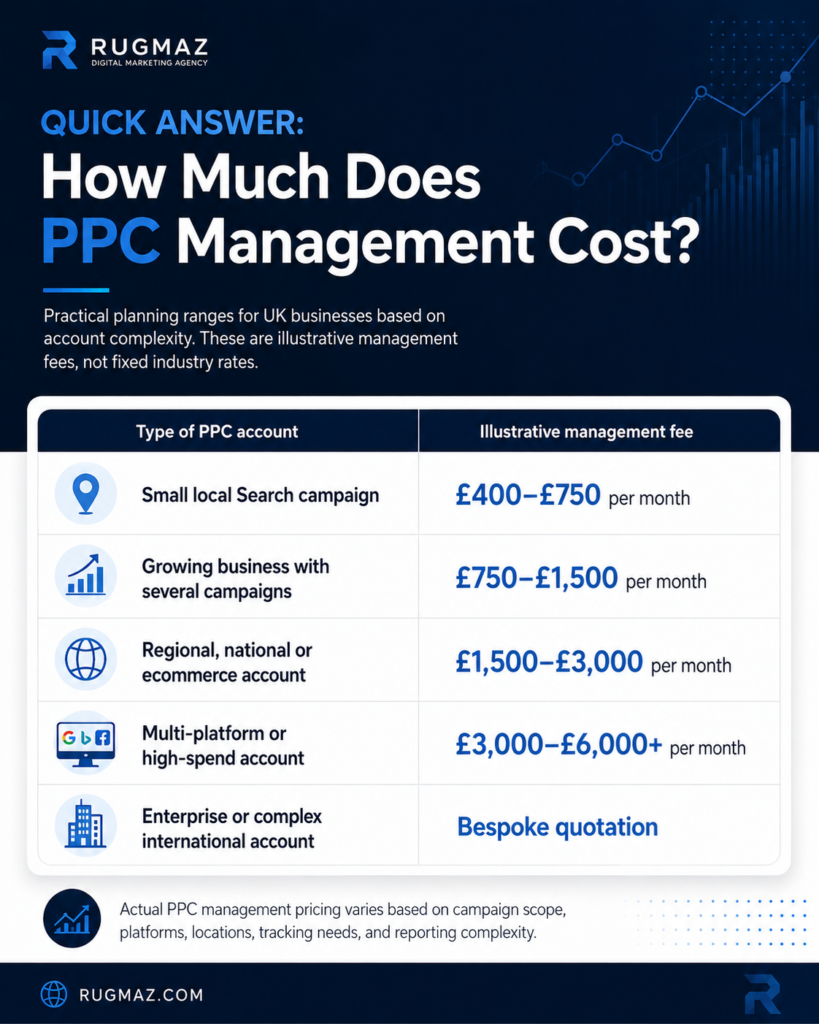
These figures normally exclude advertising spend, VAT, landing-page development, professional video production and paid software.
A basic campaign for one service in one location will not require the same resources as an ecommerce account with thousands of products, several markets and multiple advertising platforms.
That is why a reliable agency should review the account and business objectives before confirming its price.
PPC Management Cost Is Not the Same as Ad Spend
Before comparing quotes, separate the four main parts of a PPC budget.
1. Advertising Spend
Advertising spend is paid to the platform displaying your advertisements.
It may go to:
- Google Ads
- Microsoft Advertising
- Meta Ads
- LinkedIn Ads
- YouTube
- Amazon Ads
You control the amount available for the campaigns. Google also provides tools to help advertisers estimate and plan campaign budgets according to industry and location.
2. PPC Management Fee
The management fee pays the agency or consultant for the work performed on your account.
This may include:
- Campaign planning
- Keyword research
- Account setup
- Ad creation
- Conversion tracking
- Bid management
- Search-term analysis
- Budget allocation
- Reporting
- Ongoing testing
3. Initial Setup Cost
Some agencies charge a separate one-time setup fee.
A setup fee can cover work such as:
- Account and competitor research
- Campaign architecture
- Keyword grouping
- Initial ad copy
- Conversion tracking configuration
- Analytics connections
- Product-feed preparation
- Dashboard creation
A small account may have a setup fee of a few hundred pounds, while a complex ecommerce or international account can require substantially more work.
4. Additional Production and Software Costs
Some requirements sit outside normal campaign management.
These may include:
- Landing-page design and development
- Call-tracking software
- CRM integration
- Product photography
- Video production
- Graphic design
- Feed-management software
- Advanced reporting platforms
A transparent proposal should show these costs separately instead of presenting one unexplained total.
A Simple Example of the Real Monthly PPC Cost
Suppose a home-improvement company has the following budget:
| Expense | Monthly cost |
|---|---|
| Google Ads spend | £4,000 |
| Agency management | £900 |
| Call-tracking software | £60 |
| Landing-page testing | £250 |
| Total monthly investment | £5,210 |
The business is not paying £5,210 directly to Google.
Only £4,000 is advertising spend. The remaining amount supports the management, measurement and improvement of the campaigns.
This distinction is important when comparing PPC services pricing. A proposal with a lower management fee may exclude tracking, landing-page support or regular campaign testing.

The Main PPC Agency Pricing Models
PPC providers use several pricing structures. No single model is automatically better than the others. The right option depends on the account and the clarity of the agreement.
1. Fixed Monthly Retainer
A fixed retainer means the business pays the same management fee each month.
For example:
- Advertising spend: £5,000
- Monthly management retainer: £1,000
- Total before additional services: £6,000
This model works well when the monthly workload remains relatively consistent.
A fixed retainer gives the client predictable costs and allows the agency to plan enough time for optimisation, reporting and communication.
The proposal should still define the scope. It should explain:
- How many advertising platforms are covered
- How many campaigns are included
- How often optimisation takes place
- Whether tracking support is included
- Whether landing-page advice is included
- How frequently reports and meetings are provided
Without a defined scope, a “monthly management package” can mean almost anything.
2. Percentage of Advertising Spend
Some agencies calculate their fee as a percentage of monthly ad spend.
A typical proposal might charge 10%, 15% or 20% of the advertising budget, often with a minimum monthly fee.
| Monthly ad spend | 10% fee | 15% fee | 20% fee |
|---|---|---|---|
| £3,000 | £300 | £450 | £600 |
| £7,500 | £750 | £1,125 | £1,500 |
| £15,000 | £1,500 | £2,250 | £3,000 |
| £30,000 | £3,000 | £4,500 | £6,000 |
Percentage pricing can be useful when an account is expected to grow. As the campaigns expand, the agency has more budget, data and responsibility to manage.
However, the percentage should not be accepted without considering workload.
A campaign spending £20,000 on one brand term may be easier to manage than an account spending £8,000 across ten services, forty locations and two advertising platforms.
Ad spend alone does not always reflect account complexity.
3. Base Retainer Plus Percentage
A hybrid pricing model combines a fixed monthly retainer with a smaller percentage of advertising spend.
For example:
- Base retainer: £500
- Variable fee: 8% of ad spend
- Monthly ad spend: £10,000
- Total management fee: £1,300
The base fee covers the minimum level of strategic work required every month. The percentage allows pricing to increase when the account grows.
This model can be suitable for expanding ecommerce brands, multi-location businesses and companies whose advertising budgets change throughout the year.
4. Hourly PPC Consulting
Hourly pricing is often used for limited or specialist work, such as:
- A Google Ads audit
- Conversion tracking repairs
- Strategy consultation
- Account restructuring
- Staff training
- Merchant Center troubleshooting
- Analytics implementation
The current Clutch PPC pricing guide reports that many agencies listed on its global platform charge between $100 and $149 per hour. This is not a fixed UK rate, but it shows how specialist expertise and project scope can influence professional PPC costs.
Hourly pricing can work well for a defined task. It is less predictable for continuous management because the number of hours may change each month.
5. Performance-Based PPC Pricing
Performance pricing connects part of the fee to an agreed result.
That result might be:
- A qualified lead
- A completed sale
- Revenue generated
- A booked appointment
- A target cost per acquisition
- A specific return on ad spend
This structure sounds attractive, but it only works when tracking is reliable and both parties agree on how performance will be measured.
For example, the contract should explain:
- What qualifies as a valid lead
- How duplicate enquiries are treated
- Whether cancelled sales count
- Who is responsible for answering calls
- How offline sales are recorded
- How repeat customers are attributed
- Whether the fee applies to revenue or profit
A safer arrangement is often a standard retainer with a clearly defined performance bonus.
What Should Be Included in PPC Services Pricing?
A professional PPC fee should cover more than checking an account once a month.
The exact work will vary, but the following areas should normally be discussed in the proposal.
Business and Market Research
Campaign planning should begin with the business, not with a list of keywords.
The manager should understand:
- The company’s products or services
- Target customer
- Service locations
- Average sale value
- Profit margins
- Sales cycle
- Seasonal demand
- Main competitors
- Growth objectives
- Lead-handling process
A campaign can generate many conversions and still be unprofitable if the wrong conversions are being measured.
Campaign Architecture
A strong structure provides control over budgets, bidding, messages and reporting.
Campaigns may be separated by:
- Product category
- Service
- Location
- Brand and non-brand searches
- Customer type
- Profit margin
- Search intent
- Campaign objective
Poor structure can hide weak performance. One successful service may make an entire account appear profitable while several other campaigns continue wasting money.
Keyword and Search-Intent Research
Keyword research is not simply collecting phrases with high search volume.
The manager should identify:
- High-commercial-intent searches
- Relevant long-tail keywords
- Location-based keywords
- Brand terms
- Competitor terms
- Research-focused searches
- Negative keywords
- Common irrelevant searches
Search terms should continue to be reviewed after launch. Actual user queries often reveal opportunities and wasted spending that were not obvious during initial research.
Ad Copy and Testing
Advertisements should communicate why a customer should choose the business.
Testing may cover:
- Different benefits
- Offers
- Calls to action
- Trust signals
- Pricing messages
- Local references
- Urgency
- Product features
- Customer pain points
The objective is not to change wording for the sake of activity. Each test should answer a useful question about what motivates the target customer.
Conversion and Revenue Tracking
Tracking is one of the most important parts of PPC management.
Depending on the business, conversions may include:
- Contact forms
- Phone calls
- Purchases
- Bookings
- Quote requests
- WhatsApp messages
- Live-chat enquiries
- Downloads
- Trial registrations
- CRM-qualified leads
For ecommerce and lead-generation campaigns, assigning accurate values helps the platform distinguish between actions of different commercial importance. Google explains this approach in its official guide to conversion value measurement and value-based bidding.
A form submission worth £50 in expected profit should not always be treated in the same way as a sale worth £2,000.
Bid and Budget Management
Google Ads offers bidding strategies for different objectives, including clicks, visibility, conversions and conversion value. Its official bid strategy guide explains why the selected strategy should match the campaign goal.
Professional management may include:
- Choosing an appropriate bidding approach
- Controlling budget distribution
- Monitoring campaign limitations
- Adjusting targets
- Reviewing device performance
- Comparing locations
- Analysing time and day performance
- Preventing one campaign from consuming the entire budget
Automation can process large amounts of data, but it still requires accurate inputs, suitable goals and human oversight.
Ongoing Optimisation
A properly managed account should evolve as new data becomes available.
Ongoing work may include:
- Reviewing search terms
- Adding negative keywords
- Reallocating budgets
- Testing ad messages
- Pausing weak keywords
- Improving geographic targeting
- Excluding poor placements
- Reviewing lead quality
- Checking tracking accuracy
- Testing landing pages
- Comparing customer acquisition costs
- Investigating sudden performance changes
The agency should be able to explain why changes were made and what those changes were expected to improve.
Reporting That Connects Ads to Business Results
A useful report should not stop at clicks and impressions.
It should help the business understand:
- How much was spent
- How many meaningful conversions occurred
- What each conversion cost
- Which campaigns produced the best results
- Whether lead quality improved
- How much revenue was recorded
- What return was generated
- What problems were identified
- What will be tested next
Reporting should make decisions easier, not make the campaign look more complicated.
Rugmaz includes analytics and performance reporting within its broader digital marketing services.
What May Not Be Included in PPC Agency Fees?
Always ask whether the following services are included or billed separately:
- Landing-page copywriting
- Landing-page development
- Graphic design
- Video production
- Product-feed optimisation
- CRM configuration
- Offline conversion imports
- Call-tracking subscriptions
- Analytics repairs
- Photography
- Email follow-up systems
- Sales-team training
These services can improve campaign performance, but they require additional time and expertise.
A cheaper proposal may only cover the advertising platform. A more expensive proposal may include the entire path from click to qualified customer.
What Causes PPC Management Costs to Increase?
Several factors affect how much work an account requires.
Number of Campaigns
One campaign for one local service is relatively simple. Twenty campaigns covering different products, audiences and locations require more frequent analysis and coordination.
Number of Advertising Platforms
Managing Google Search alone is different from managing:
- Google Search
- Performance Max
- Google Shopping
- YouTube
- Microsoft Advertising
- Meta Ads
- LinkedIn Ads
Each platform has its own creative requirements, targeting options and reporting methods.
Number of Locations
Location-specific campaigns may need separate budgets, advertisements, landing pages and conversion targets.
A business targeting Manchester only will usually require less work than a company advertising across the UK, Ireland and several European markets.
Ecommerce Complexity
Ecommerce accounts may involve:
- Thousands of products
- Product-feed errors
- Different margins
- Out-of-stock products
- Seasonal promotions
- Shopping campaigns
- Performance Max
- Merchant Center issues
- New customer targets
- Revenue attribution
The agency may also need to allocate more spend to products that produce stronger margins rather than those generating the most revenue.
Tracking Requirements
A simple form confirmation page may be easy to track.
A business that needs to connect advertising data with phone calls, CRM stages, offline sales and recurring revenue will require more advanced implementation.
Industry Competition
Competitive industries usually demand closer control over keywords, budgets and lead quality because an irrelevant click can be expensive.
The correct question is not whether clicks are cheap. It is whether the final cost of acquiring a customer leaves enough profit.
How Much to Charge for PPC as a Freelancer or Agency
Professionals asking how much to charge for PPC should begin with the expected workload, not with a competitor’s package.
Estimate the monthly hours required for:
- Research
- Campaign building
- Optimisation
- Reporting
- Meetings
- Tracking support
- Creative coordination
- Landing-page reviews
- Client communication
- Administration
Then calculate a sustainable fee.
For example:
- Estimated monthly work: 14 hours
- Sustainable hourly value: £70
- Direct management value: £980
- Software and administration allowance: £120
- Suggested monthly fee: £1,100
This calculation is more reliable than charging £300 simply because another freelancer advertises a £300 package.
Your pricing should also reflect:
- Experience
- Level of responsibility
- Account complexity
- Response expectations
- Reporting requirements
- Contract risk
- Specialist tools
- Commercial value of the work
A low fee can become unprofitable when the client expects daily communication, multiple platforms, new landing pages and detailed weekly reports.
A Practical PPC Pricing Framework for Service Providers
The following framework can be adapted according to scope.
| Service level | Illustrative monthly fee |
|---|---|
| Single-platform local account | £400–£750 |
| Several campaigns or locations | £750–£1,500 |
| Ecommerce or national account | £1,500–£3,000 |
| Multi-platform growth management | £3,000–£6,000+ |
| Enterprise account | Bespoke pricing |
A setup fee may also be added when the first month requires substantial research, tracking and account construction.
Every package should state:
- Included platforms
- Approximate campaign scope
- Reporting frequency
- Meeting frequency
- Tracking responsibilities
- Creative responsibilities
- Excluded services
- Notice period
- Minimum fee
- Conditions that trigger repricing
Clear scope protects both the agency and the client.
Why the Cheapest PPC Agency Can Cost More
Consider two agencies managing identical advertising budgets.
Agency A
- Advertising spend: £4,000
- Management fee: £400
- Qualified leads: 15
- Total investment: £4,400
- Cost per qualified lead: £293
Agency B
- Advertising spend: £4,000
- Management fee: £1,000
- Qualified leads: 40
- Total investment: £5,000
- Cost per qualified lead: £125
Agency B charges £600 more for management but produces qualified leads at a much lower total cost.
This example does not mean the expensive agency will always win. It shows why management fees should be considered alongside commercial performance.
The most useful measures may include:
- Cost per qualified lead
- Cost per sale
- Customer acquisition cost
- Conversion rate
- Revenue
- Gross profit
- Return on ad spend
- Customer lifetime value
Questions to Ask Before Accepting a PPC Proposal
Ask each provider the same questions so the quotations can be compared fairly.
- Is advertising spend separate from the management fee?
- Which platforms and campaign types are included?
- Is there an initial setup fee?
- Who will manage the account?
- How frequently will the account be reviewed?
- Is conversion tracking included?
- Will phone calls and offline sales be tracked?
- Are landing-page recommendations included?
- Does the fee cover ad copy and creative production?
- How will qualified leads or revenue be measured?
- Will I retain ownership of the advertising account?
- Are there minimum contract terms?
- What reporting will I receive?
- What services would create additional charges?
- When would the management price be reviewed?
The provider should answer these questions clearly before asking the business to sign a contract.
Warning Signs in PPC Services Pricing
Be cautious when an agency:
- Guarantees a fixed number of sales before reviewing the business
- Hides the advertising budget inside one total fee
- Refuses to provide account access
- Cannot explain how conversions will be tracked
- Reports only clicks and impressions
- Uses an unclear percentage markup
- Charges extra fees that were not disclosed
- Applies the same strategy to every industry
- Never discusses profit or lead quality
- Encourages spending more before fixing obvious campaign problems
No provider can guarantee profitable results before understanding the market, offer, website, competition and sales process.
A trustworthy agency should explain the strategy, risks, measurement process and limitations honestly.
Should You Manage PPC Yourself or Hire an Agency?
Managing PPC internally can work when the business has:
- Someone with advertising experience
- Enough time for regular analysis
- Reliable tracking
- A simple campaign structure
- A controlled testing budget
Professional management becomes more useful when:
- Spending is increasing
- Lead quality is inconsistent
- Tracking is unreliable
- Several campaigns or platforms are involved
- The account has stopped improving
- The team lacks time
- Management decisions are based on clicks instead of revenue
PPC can provide faster visibility, while organic search helps build long-term traffic. Businesses planning both channels can explore Rugmaz’s SEO services for UK companies alongside paid advertising.
For broader guidance on platform spend, campaign types and cost per click, see the complete PPC pricing guide for 2026.
Is PPC Management Worth Paying For?
PPC management is worth its cost when the improvement in campaign performance is greater than the fee.
Good management may help a business:
- Reduce irrelevant traffic
- Improve tracking
- Find better search terms
- Increase conversion rates
- Generate higher-quality leads
- Identify profitable locations
- Stop wasting money on weak campaigns
- Scale campaigns with stronger returns
However, management cannot fix every business problem.
Paid advertising will struggle when the company has:
- An unclear offer
- Uncompetitive prices
- A slow or confusing website
- Weak customer service
- Poor sales follow-up
- Insufficient profit margins
- No method for measuring outcomes
The advertising account and the wider sales process should work together.
How Rugmaz Approaches PPC Management Pricing
At Rugmaz, PPC pricing should reflect the work required to reach a business objective, not an arbitrary one-size-fits-all package.
A suitable plan begins with:
- Understanding the offer
- Reviewing the target market
- Evaluating existing campaigns
- Checking conversion tracking
- Estimating campaign scope
- Identifying the right platforms
- Agreeing on meaningful performance measures
This allows the management quotation to separate:
- Platform advertising spend
- Campaign management
- Setup requirements
- Tracking work
- Optional landing-page or creative services
Businesses can contact Rugmaz for a PPC consultation and receive a proposal based on their market, objectives and expected account complexity.
Final Answer: How Much Does PPC Management Cost?
There is no universal PPC management price.
A small local campaign may require a management budget of approximately £400 to £750 per month. A growing company with several campaigns may spend £750 to £1,500. Complex ecommerce, national or multi-platform accounts may require £1,500 to £6,000 or more.
The final PPC management cost depends on:
- Campaign complexity
- Number of platforms
- Advertising spend
- Target locations
- Tracking requirements
- Reporting needs
- Landing-page support
- Ecommerce requirements
- Level of strategic involvement
When comparing PPC agency fees, look beyond the monthly number.
Ask what is included, who will perform the work, how conversions will be measured and whether the agency will connect campaign activity to leads, sales and profit.
The cheapest PPC service is not always the most affordable. The most valuable provider is the one that manages your complete advertising investment responsibly and helps you understand what the campaigns are producing.
Frequently Asked Questions
How much does PPC management cost per month?
A small UK account may cost approximately £400 to £750 per month to manage. Growing or more complex accounts may cost between £750 and £3,000, while multi-platform and enterprise campaigns can require higher bespoke fees. Advertising spend is usually separate.
What are typical PPC agency fees?
PPC agencies may charge a fixed retainer, a percentage of advertising spend, an hourly rate or a combination of these models. The fee should reflect the account’s workload and complexity.
What percentage do PPC agencies charge?
Percentage-based agreements commonly use a share of monthly ad spend, often with a minimum fee. The exact percentage should be evaluated alongside campaign complexity and included services.
Is PPC ad spend included in the management fee?
Usually not. Ad spend is paid to the advertising platform, while the management fee pays the specialist or agency responsible for managing the campaigns. Always confirm this in writing.
What should PPC management include?
A professional service may include research, campaign setup, keyword management, ad testing, conversion tracking, bid optimisation, budget allocation, reporting and strategic recommendations.
How much should a freelancer charge for PPC?
The freelancer should calculate the estimated hours, required expertise, software costs, communication time and responsibility involved. A simple local account may start at a few hundred pounds per month, while complex accounts should be priced higher.
Are PPC setup fees normal?
Yes. Setup fees may cover research, account structure, initial advertising copy, tracking configuration and analytics connections. The agency should explain exactly what the setup fee covers.
Does PPC management include landing pages?
Not always. Some providers include recommendations but charge separately for copywriting, design and development. This should be confirmed before the work begins.
Is a fixed fee better than percentage pricing?
Neither model is automatically better. Fixed pricing provides predictability, while percentage pricing can scale with advertising spend. The best model is the one that matches the account’s actual workload.
Can an agency guarantee PPC results?

An agency can provide forecasts and performance targets, but it cannot honestly guarantee sales without considering market demand, competition, website quality, pricing and the client’s sales process.