Quick answer: Ranking in Manchester is not the same as ranking in “a UK city”. Google decides who appears in the map results largely by relevance, distance and prominence, and Manchester is an awkward place for all three. Councils, postcodes and everyday speech do not agree on where “Manchester” starts and stops. A business in MediaCityUK, Altrincham or Stockport can be 15 minutes from the city centre and still be invisible for “Manchester” searches because of how its listing, address and pages are set up. This guide shows you how to fix that, district by district.
In this guide
- The three Manchester traps that hold businesses back
- How Google actually decides who shows up
- A district-by-district intent map
- The 30-minute Manchester local pack audit
- Location pages that are not doorway pages
- Reviews, links and mentions that carry real local weight
- A seasonal content calendar for Manchester
- The 90-day plan
- Mistakes we see again and again
- FAQs
1. The three Manchester traps that hold businesses back
Most agency pages on this topic list the same neighbourhoods and promise “more visibility”. They skip the structural problems that decide who wins. Here are the three we would check first.
Trap 1: The boundary trap
Greater Manchester is a city region made up of ten boroughs: Bolton, Bury, Manchester, Oldham, Rochdale, Salford, Stockport, Tameside, Trafford and Wigan. You can confirm the structure on the Greater Manchester Combined Authority website. Customers rarely think in boroughs. Someone in Salford Quays will search “dentist Manchester”, and so will someone in Altrincham. But your business may sit in Salford or Trafford on paper. If your website, listing and citations only say the borough name, you can miss the broader “Manchester” demand. If they only say “Manchester” when you are not in the city, you can look inconsistent and lose trust.
What to do: Decide which names your real customers use, then reflect both. For example: “Based in Salford Quays, serving Manchester city centre and Greater Manchester”.
Trap 2: The postcode trap
City-centre postcodes start with M, such as M1 to M4, but many Greater Manchester towns use other prefixes. Altrincham is WA14 and WA15, Stockport is SK, Oldham is OL, and Bolton is BL. Sale uses M33. Wilmslow (SK9) is in Cheshire, not Greater Manchester, which trips up a lot of directories and data aggregators.
What to do: Do not assume a postcode proves you are “in Manchester” to a customer or a directory. Check how each major directory has categorised you, and make sure the address you use is written the same way everywhere.
Trap 3: The proximity trap
Google’s local results lean heavily on distance from the searcher. A business in the Northern Quarter will often beat a stronger business in Didsbury for someone standing in the city centre, and the reverse is true further south. A single listing cannot dominate the whole region. That is not a failure of your SEO. It is how the system works.
What to do: Stop chasing one “Manchester” ranking. Plan for the areas you can realistically win, and use other tools (pages, reviews, ads) for the rest.
2. How Google actually decides who shows up
Google states that local results are based mainly on relevance, distance and prominence, and explains the idea on its page about improving your local ranking. In plain English:
- Relevance: how well your profile matches what the person searched for. Categories, services and the wording on your site all feed this.
- Distance: how far you are from the searcher, or from the location they named.
- Prominence: how well known you are, which includes reviews, links, mentions and your wider web presence.
You control relevance and prominence far more than distance. In a dense city like Manchester, where many competitors sit within a few streets of each other, prominence is usually the deciding factor.
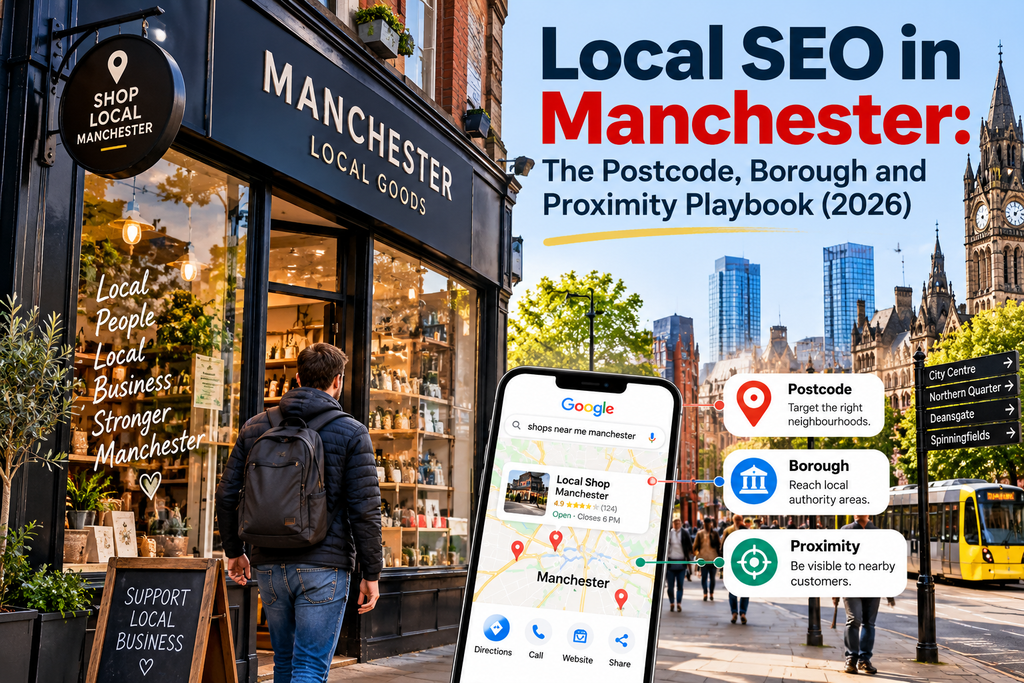
3. A district-by-district intent map
Search intent shifts with the area. The patterns below are our working framework based on how these areas tend to be used, not Google data, so test them against your own Search Console queries.
City centre: Northern Quarter, Ancoats, Spinningfields, Deansgate (mostly M1 to M4)
- Customer mix: office workers, residents in apartments, visitors and students.
- Typical behaviour: fast, mobile, “open now” style searches. Hours, photos and reviews decide who gets the click.
- Priority: accurate opening hours, fresh photos, strong review velocity, and clear directions for people arriving by tram, train or on foot.
- For professional services: show credentials, named people and case outcomes, because buyers are comparing trust.
Salford Quays and MediaCityUK (M50)
- Customer mix: media and tech firms, residents and commuters.
- Trap: it is Salford, not Manchester city. Reflect both in your wording.
- Priority: B2B proof such as client names (with permission), case studies and clear office details.
South Manchester: Didsbury, Chorlton, Withington, Fallowfield
- Customer mix: families, young professionals and a large student population.
- Typical behaviour: neighbourhood loyalty and recommendation-driven searches.
- Priority: community reviews, local sponsorships and location pages with real neighbourhood detail.
Trafford and the south-west: Altrincham, Sale, Stretford
- Customer mix: affluent suburbs and commuters.
- Trap: WA postcodes and a different borough. Customers still say “Manchester”.
- Priority: pages that mention both the town and Greater Manchester, plus reviews that name the town.
Stockport and the south-east
- Customer mix: a distinct town centre with its own identity.
- Priority: treat Stockport as its own market, not an outpost of Manchester. People here often search with the town name first.
4. The 30-minute Manchester local pack audit
Before you spend money, run this simple audit.
- List your 10 most valuable searches. Mix service plus area, for example “[service] Northern Quarter”, “[service] Didsbury” and “[service] Manchester”.
- Check each search in a private window, on mobile, with your location set as realistically as you can. Note whether you appear in the map results, the organic results, or neither.
- Record the top three competitors for each search. Look at their review count, rating, categories and photos.
- Check your listing against the winners. Are your primary and secondary categories right? Are your services filled in? Are your hours correct, including bank holidays?
- Check consistency. Does your business name, address and phone appear identically on your site, listing and top directories?
- Open Search Console and sort queries by impressions. Find searches where you appear on page 3 to 5 but get no clicks, which is the opportunity that matters most.
Write findings in a simple spreadsheet. Most businesses are surprised to find that their biggest gap is not rankings but weak or missing listing detail.
5. Location pages that are not doorway pages
Creating dozens of near-identical pages such as “Plumber in Chorlton”, “Plumber in Withington” and “Plumber in Sale” with only the name swapped is a well-known way to get ignored or penalised. Google’s guidelines for representing your business also warn against misleading location presentation on your profile.
A genuine local page needs things that cannot be copied:
- Real local detail: nearby landmarks, tram stops, main roads, or typical property or business types in that area.
- A real example: a job, project or customer story from that district, with permission.
- Local reviews: quotes from customers in or near that area.
- Local questions: answers to things people there actually ask, such as parking, access or response times.
- A reason to exist: if you cannot write 400 genuinely useful words about an area, merge it into a broader page.
Service-area businesses: if you visit customers rather than welcoming them, make sure your profile shows your service areas honestly, and hide your home address if it is not a public premises.
6. Reviews, links and mentions that carry real local weight
Reviews
- Ask every happy customer, at the moment they are happiest.
- Make it easy with a direct review link, and never script or incentivise the wording.
- Reply to every review in a human voice. Natural mentions of the service and area help relevance without stuffing.
- Respond calmly to negative reviews. Prospective customers read these closely.
Links and mentions
In a crowded market, a few strong local mentions beat hundreds of weak directories. Ideas that suit Manchester:
- Local business groups, chambers of commerce and industry bodies
- Charity events, community sports clubs and school sponsorships
- Local press, blogs and event listings
- University and student partnerships in the south of the city
- Neighbouring, non-competing businesses that can refer to you
Citations
Keep your name, address and phone number identical everywhere. Fix inconsistencies before you build new listings.
7. A seasonal content calendar for Manchester
Manchester has a heavy event and student calendar. Use it to publish timely, useful content. These are content ideas to test, not guaranteed traffic sources.
- September and October: student arrival and new term, with services for new residents and landlords.
- November and December: Christmas markets, festive trading hours and gift guides.
- Match days and large concerts: parking, hours and access updates for nearby businesses.
- Spring and summer: festivals, outdoor seating, and garden or home services.
- Any time: bank holiday hours, which you should update on your profile every time.
8. The 90-day plan
Days 1 to 14: Foundations
- Run the local pack audit.
- Correct categories, services, hours, photos and description.
- Fix name, address and phone inconsistencies.
Days 15 to 45: Relevance
- Rewrite or create core service pages with clear Manchester context.
- Build two or three genuinely useful district pages.
- Add FAQ content based on real customer questions.
Days 46 to 75: Prominence
- Launch a steady review programme.
- Pursue five local mentions or links that you could be proud of.
- Post updates and new photos on your profile weekly.
Days 76 to 90: Measure and decide
- Compare impressions, calls, direction requests and clicks to your starting point.
- Double down on the districts that moved. Pause the ones that did not.
- Use paid search to cover areas where organic is still out of reach. Our guides to Google Ads and Meta advertising explain how to fill those gaps.
9. Mistakes we see again and again
- Using a virtual office or mailbox as your “Manchester address”. It is a fast route to verification trouble. If you get stuck, read our guides on video verification failures and how to recover a suspended profile.
- Stuffing “Manchester” into your business name. Use your real-world name.
- Targeting only “Manchester” when your best customers live in a specific district or town.
- Copying competitor location pages and swapping the place name.
- Ignoring conversion. Traffic is wasted if your pages do not turn visits into enquiries. See our conversion rate optimisation guide.
- Neglecting basics. Our local SEO best practices cover the foundations in more detail.
10. FAQs
How long does local SEO take in Manchester?
Expect early improvements in listing performance within weeks, but stronger organic and map rankings usually take months in a competitive market. The timeline depends on your starting point, your competitors and how much real-world proof you can publish.
Can I rank in Manchester if my business is in Salford or Stockport?
Yes, but you need to show Google and customers that you serve Manchester. Reflect your true location, and add genuine service-area and page content. Do not pretend to be somewhere you are not.
Do I need a different page for each Manchester area?
Only if you can say something genuinely different and useful for each one. A few strong pages are better than many thin ones.
Is a Manchester virtual office address a good idea?
Generally no, if it means presenting an unstaffed address as your premises. Google’s guidelines are strict on this, and it can lead to verification or suspension problems.
How many reviews do I need?
There is no magic number. Look at the top three competitors for your main searches and aim to match their quality and recency, then keep going.
Is local SEO enough, or do I need ads too?
For many Manchester businesses the best results come from both. Organic and map listings build long-term visibility, while ads give you immediate coverage for competitive searches and districts you do not yet rank in.
Do I need an agency?
Not always. A confident owner can do the foundations in this guide. Help makes sense when the market is competitive, time is short, or you have already tried and stalled.
Ready to win your part of Manchester?
If you want a clear view of where you stand, start with the audit in section 4. If you would like a second opinion, talk to Rugmaz and we will tell you which districts are worth targeting first. If you are launching a new business, our SEO services for UK startups are built for exactly that stage.